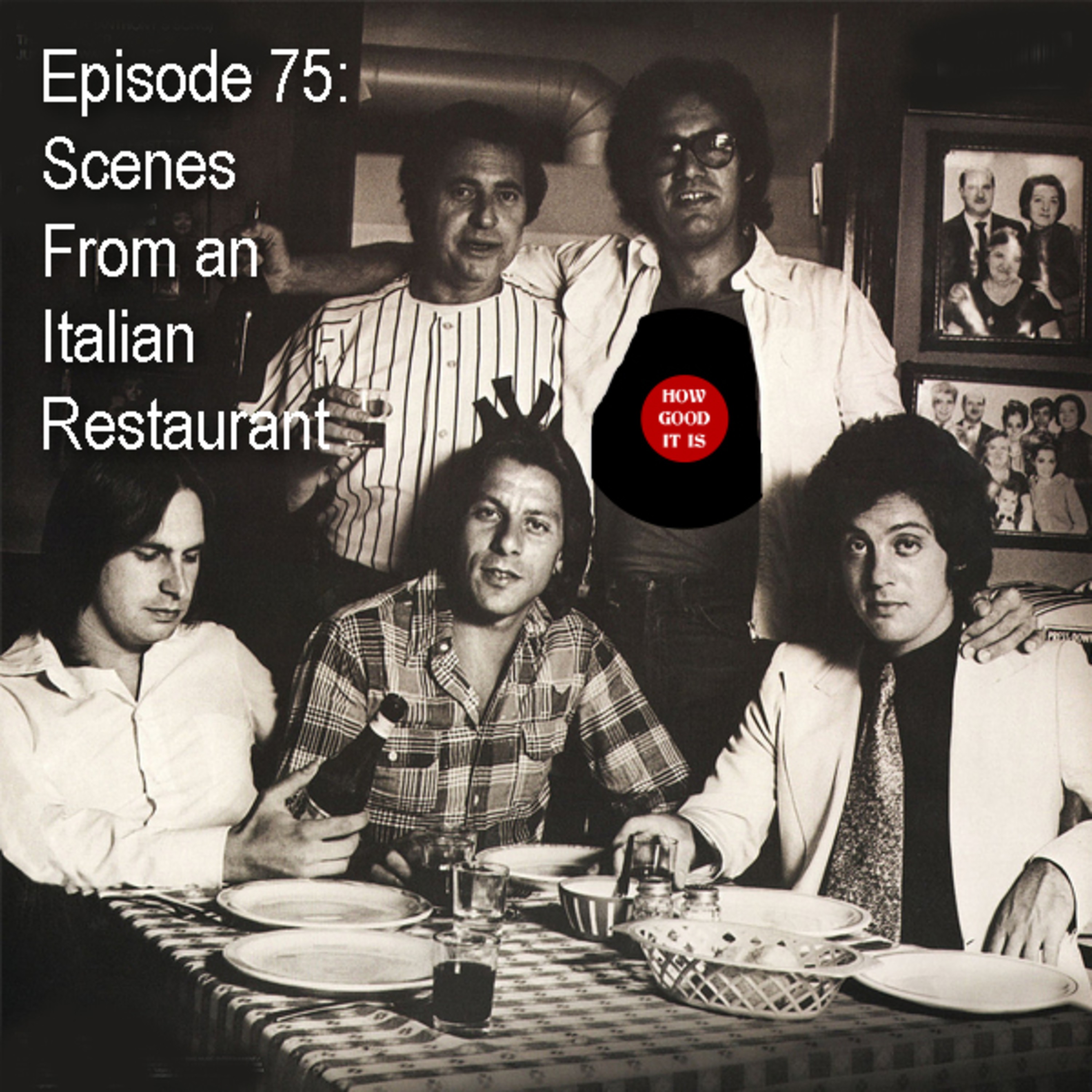
Billy Joel’s longest studio track has a lot of Long Island landmarks in it, and most of them are easily identified. But what restaurant was he referring to in this song? This week we look at some contenders.
Sometimes when I’m looking for a show to cover, I look at any potential patterns I may have been following, just to break out of them. Have I been doing too many hard rock songs? Too many from a given decade? Too many of a specific genre? That sort of thing. I like to use some songs as an entryway to discovering other songs. So, for instance, I know that “Classic Rock” songs tend to pull in the downloads, but I’ve gotten comments from people who tune in to hear about “Another Brick in the Wall” but stay to learn about “Killing Me Softly With His Song.”
So in searching for patterns, I also look for songs I don’t like to see if I can defend them, or make them somehow interesting to me (looking at you, Episode 30), or just get into “What haven’t I done so far?”
And that’s pretty much why I went looking for a song that begins with the letter Q.
But as usual, it turned into one of those things where your basic party song turns out to have a richer history behind it than one would ordinarily suspect. (A lot of times I think I’d like to cover a song and the research turns out to be a bust.) So check out the story behind Gary US Bonds’ song and how its popularity with another hitmaker led to his working on Bonds’ comeback hit:
Incidentally, I’ve started doing the artwork for each episode early in the process, since it makes for a great procrastination project. How am I doing so far?
Gary US Bonds was still just “US Bonds” on the record labels until shortly after this record came out. This week we look at the story behind this song, and how it influenced another hitmaker to write and produce Bonds’ 1981 comeback hit.
Let me open up with an apology for the delayed show. Those who know me well know that there was a medical issue in the family that distracted me, and that’s got to come first, right?
For me, “Classical Gas” is one of those songs that passes in and out of my consciousness. I forget about it for a long time, and then I can’t get enough of it for awhile. And when I did that trivia question last week about instrumentals, “Classical Gas” returned to my radar and I said, “Ooh, I gotta do this one!”. Coincidentally, a listener happened to request that I cover the song, and I was only too happy to oblige, having already started the research. (My reply to him was “boy are you in for a surprise.”)
This is the video that Williams re-scored for its use on the Smothers Brothers’ Comedy Hour. Try to picture it using Beethoven’s Fifth Symphony; I don’t think it works nearly as well. (Also, this video–which was posted to YouTube by Mason Williams–sounds like a slightly different mix, but I could be wrong on that one.)
And I didn’t promise you this in the show, but I’m going to link it here anyway, because I like it so much. This is the cover of “Classical Gas” by Vanessa Mae from 1995:
And here is the episode itself, for those who like to listen or download from here:
The Boss and The Jester (if you believe some “American Pie” theories) at the Rock and Roll Hall of Fame Induction concert, 1988.
So about a million years ago, back in Episode 8 (“Like a Rolling Stone”), I spent a bunch of time during that show talking about the snare shot that opened the song, and how it was practically the Shot Heard Round The World and how it Changed Everything on the rock and roll landscape.
I still believe that, and that particular episode of the podcast remains one of my favorites (if you do nothing else, follow the link to the interactive video and have a blast).
But as it turns out, this past weekend I came across a quotation from Bruce Springsteen that underlines and validates everything I said, and maybe a little more poetically, because, you know, Bruce Springsteen can be a brilliant lyricist and I’m just some guy spouting off. Springsteen was the person who inducted Bob Dylan into the Rock and Roll Hall of Fame, and this was part of his speech:
The first time that I heard Bob Dylan, I was in the car with my mother, and we were listening to, I think, WMCA, and on came that snare shot that sounded like somebody kicked open the door to your mind, from “Like a Rolling Stone.” And my mother, who was no stiff with rock & roll, she said, “That guy can’t sing.” But I knew she was wrong. I sat there, I didn’t say nothin’, but I knew that I was listening to the toughest voice that I had ever heard. It was lean, and it sounded somehow simultaneously young and adult, and I ran out and I bought the single. I played it, then I went out and I got Highway 61, and it was all I played for weeks. Bob’s voice somehow thrilled and scared me. It made me feel kind of irresponsibly innocent. And it still does. But it reached down and touched what little worldliness a 15-year-old kid in New Jersey had in him at the time.
See? Bruce Springsteen agrees with me, so I can’t be wrong.
In 1981 Bonnie Tyler had exactly one hit, 1977’s “It’s a Heartache”, so it was no mystery why people were calling her a one-hit wonder. Her record label cut her loose, so she found a new manager and talked Jim Steinman, the guy responsible for Meat Loaf’s Bat Out of Hell, into partnering with her for a new album. Steinman wasn’t easily convinced, but ultimately he came to her with a couple of older songs that he thought she could record, and when she agreed to those, he came to her with a nearly complete package: here’s the song, here’s who else is going to be performing on it, you just need to come in and sing your little heart out.
That doesn’t match with the popular narrative, that “Total Eclipse of the Heart” was originally written for Meat Loaf as part of his follow-up album to Bat Out of Hell, but it turns out that the guy responsible for that popular narrative about Meat Loaf was…Meat Loaf. But the story caught on, because if you listen to “Eclipse,” you could easily imagine its huge levels of production as being Meat Loaf-esque. But “Eclipse” wasn’t written for him, nor was the other song (a hit for Air Supply) to which he laid the same claim.
I was about 15 when I saw Devo performing on Saturday Night Live that October night in 1978. They performed “Jocko Homo”, which gave newcomers (like me) a little bit of an introduction to themselves with that lyric “Are we not men?/We are Devo”.
A friend of mine had already turned me on to Gary Numan a few months earlier, and this felt like the logical next step. And as I sat there in the darkened room (’cause I wasn’t supposed to be up), bathing in the glow from the TV, I was struck in much the same way I was a couple of years later when the B-52s appeared on the same show. “This is SO WEIRD,” I said to myself. “And it’s SO COOL.”
Mark Mothersbaugh jumping back and forth between the microphone and the keyboards, and when the band took off the yellow jumpsuits, and Mothersbaugh had trouble removing his because even though the pants were breakaway, he couldn’t remove the sleeves for some reason, and the whole thing told me that stuff was changing. Music is changing. Maybe even culture is changing. And then they played their cover of “(I Can’t Get No) Satisfaction” and at first I admit I was a little put off, but I relaxed into it and even by the time that was over I was all, “yeah, this is cool.” And then it turned out that Jagger really liked it too.
Here’s a link to that performance on Tumblr. Who knows how long it’ll last.
Devo’s one trip to the Top 40 was a cultural touchstone partly because some people misunderstood the intent of the lyrics, and partly because MTV was starved for programming.
This week’s episode arose from an essay I published on my blog several years ago. I was looking back on some of the stuff I wrote and found this particular piece, and thought, with a little re-writing it might make a decent episode of the podcast. So, re-write I did, and I’m generally happy with the result, though I’m once again fighting off a respiratory thing.
James “Sugarboy” Crawford
Anyway: James “Sugarboy” Crawford wrote “Iko Iko” in 1953, and recorded it with his band, the Cane Cutters. That version didn’t go anywhere, chart-wise, and neither did any cover that followed, until 1965, when Jerry Lieber and Mike Stoller, using audio from the Dixie Cups’ fooling around between takes, added a backing track and turned their version, with its nonsensical lyrics, into an international hit. The song became such a big deal that the Dixie Cups eventually received partial writing credit for the song because of all the changed lyrics.
And that’s all I’m saying here, go listen to the show.
In the early 80s, When I was in college and working at the campus radio station, once in awhile we’d play this song and announce that it was from the album, “Zager and Evans’ Greatest Hit.”
Because we were hysterically funny that way.
But Denny Zager and Rick Evans were, indeed, a One Hit Wonder. In fact, they were the very definition of the phrase, considering that they had NO other charting hits on either side of the Atlantic.
Denny Zager and Rick Evans, in that order.
That said, their one hit dominated the Summer of 1969 and provided the background soundtrack to a host of big news stories that took place during the six weeks it spent in the Number One position on the Billboard Chart.
I also learned after recording this podcast that Odessa Symphony, which provided the orchestral parts of the record, is composed entirely of high school students. The high school they came from is Permian High School, which is the setting of the book that later became the film Friday Night Lights. (The TV series was set in a fictional town.)
As promised, here’s the Futurama clip in which the song is parodied:
And although I didn’t promise it, here’s the opening to the Cleopatra 2525 show. Gina Torres, incidentally, is the one singing the show’s theme song:
And, of course, if your podcatcher doesn’t already have the show, you can listen or download right here:
And I’d like just a wee bit of credit for writing “Summer of 1969” here, and saying it at least twice during the show, without making any tired Bryan Adams jokes. You’re welcome.
Cookie Consent
We use cookies to improve your experience on our site. By using our site, you consent to cookies.
Contains information related to marketing campaigns of the user. These are shared with Google AdWords / Google Ads when the Google Ads and Google Analytics accounts are linked together.
90 days
__utma
ID used to identify users and sessions
2 years after last activity
__utmt
Used to monitor number of Google Analytics server requests
10 minutes
__utmb
Used to distinguish new sessions and visits. This cookie is set when the GA.js javascript library is loaded and there is no existing __utmb cookie. The cookie is updated every time data is sent to the Google Analytics server.
30 minutes after last activity
__utmc
Used only with old Urchin versions of Google Analytics and not with GA.js. Was used to distinguish between new sessions and visits at the end of a session.
End of session (browser)
__utmz
Contains information about the traffic source or campaign that directed user to the website. The cookie is set when the GA.js javascript is loaded and updated when data is sent to the Google Anaytics server
6 months after last activity
__utmv
Contains custom information set by the web developer via the _setCustomVar method in Google Analytics. This cookie is updated every time new data is sent to the Google Analytics server.
2 years after last activity
__utmx
Used to determine whether a user is included in an A / B or Multivariate test.
18 months
_ga
ID used to identify users
2 years
_gali
Used by Google Analytics to determine which links on a page are being clicked
30 seconds
_ga_
ID used to identify users
2 years
_gid
ID used to identify users for 24 hours after last activity
24 hours
_gat
Used to monitor number of Google Analytics server requests when using Google Tag Manager
1 minute
Marketing cookies are used to follow visitors to websites. The intention is to show ads that are relevant and engaging to the individual user.
Facebook Pixel is a web analytics service that tracks and reports website traffic.
Registers a unique ID on mobile devices to enable tracking based on geographical GPS location.
1 day
VISITOR_INFO1_LIVE
Tries to estimate the users' bandwidth on pages with integrated YouTube videos. Also used for marketing
179 days
PREF
This cookie stores your preferences and other information, in particular preferred language, how many search results you wish to be shown on your page, and whether or not you wish to have Google’s SafeSearch filter turned on.
10 years from set/ update
YSC
Registers a unique ID to keep statistics of what videos from YouTube the user has seen.
Session
DEVICE_INFO
Used to detect if the visitor has accepted the marketing category in the cookie banner. This cookie is necessary for GDPR-compliance of the website.
179 days
LOGIN_INFO
This cookie is used to play YouTube videos embedded on the website.