

Before I start this week’s windup, let me point you to a different podcast for a moment. The guys at the TMDR Podcast describe their show as being simultaneously about nothing and about everything, but they keep the shows confined to a couple of topics. I’ve been listening in on their discussions of the HBO series Westworld, and just this week they did a show where they spent some time reviewing several different podcasts, How Good It Is being among the shows they reviewed.
 I have to say, I was blown away by the level of praise they gave to the show, and I just wanted to thank them yet again, and offer up this link (click on their logo at right). Go check them out; I think you’ll have some fun.
Back in the mid-1980s I went to a Fourth of July event on Long Island. Among the pre-fireworks entertainment was music provided by The Drifters. What I didn’t realize at the time was that there were LOTS of ex-Drifters simply, er, drifting about, and many of them had gotten together and were touring as The Drifters. What’s more, all of these groups could legally do so in many places around the country.
As it happened, I was young and naive, and kinda-sorta listening to their lead singer and the way he was singing staccato style, because he was older and couldn’t hold his notes for any appreciable length of time.
So did I see The Drifters or did I see “The Drifters”? There’s an element of “both” in my eyes, because there were so many people paid to be one of The Drifters that this group could easily be made up of former members. But that didn’t mean I was watching Ben E. King or Clyde McPhatter.
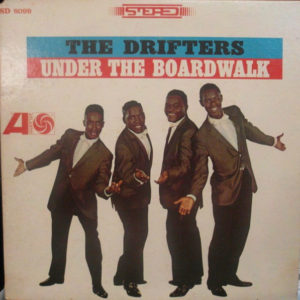 “Under the Boardwalk” was recorded the day after their lead singer Rudy Lewis died. They recruited a former member from several years ago, and before long a new version of the group had cranked out their second-biggest hit.
As usual, your podcatcher software should already have this, but if it doesn’t, you can always play it back right here:
Or, if you’re so inclined, you can go directly to the Podomatic site and download it on your own. And please leave a review wherever you get your shows from, it really helps drive traffic. Thanks!


 In the mid 1960s, a group called The Detergents released an album of novelty songs, and a couple of them caught on, but one did especially well, a parody of the Shangri-Las’ “Leader of the Pack.” Among that group was a young man named Ron Dante.
 Archies, and they had a short string of hits, peaking with “Sugar Sugar” in 1969. Dante provided all the male voices on “Sugar Sugar,” and Toni Wine provided all the female voices. So yes, you appear to hear two women—one singing low and the other singing high—but in fact they’re both Toni Wine.
 I realize it’s not fashionable to bash the teenagers these days, however in my head this one actually deserves the abuse. Most of you may not agree, but I’m gonna say my piece anyway and be done with it.
 Both “Angel Baby” and its B-Side, a track sung by a friend of the band who happened to be there for the session, are just plain bad recordings. As musicians, The Originals were not what you’d call virtuosos. As Max Bialystock says in The Producers, “I picked the wrong play, the wrong director, the wrong cast. Where did I go right?”
 The Righteous Brothers were originally part of a larger group called The Paramours. In 1962 they split up, and members Bill Medley and Bobby Hatfield began appearing in local clubs in southern California as a duo. One night, when they finished singing a song, a Marine from a nearby base shouted at them, “That was righteous, brother.” When they were signed to Moonglow Records shortly thereafter, they were asked to come up with a name for the act, and they recalled that incident. “Righteous Brothers” sounded about right for them so they ran with it.
 About two years later, they were playing in a show at San Francisco’s Cow Palace, where a record producer was conducting the band. That conductor was Phil Spector, who was looking to add some male voices to his Phillies label. Spector’s first move was to hire Barry Mann and Cynthia Weil to write a song specifically for his new act. “You’ve Lost That Lovin’ Feeling” was the result of that hire.
 The laptop on the left holds my audio elements while the one on the right is my “everyday” machine that I use for recording. The Audacity file you’re looking at is the unedited, unprocessed (via Auphonic) version of this week’s show. You can see I use two mice; one is wireless and the other one isn’t. The wired one is the one that I use for the left-hand machine, because it gives me (I think) more control and that’s where I really need it.
 Did you ever decide that you were in the market for something, let’s say you need a car, and all of a sudden you see advertisements for cars all over the place? Or, you learn a new word and suddenly you see it being used everywhere?
 So this time around we’re going to hear from musicians as diverse as Salt ‘n’ Pepa, Led Zeppelin and Linda Lyndell. Who? Just go listen, you’ll be fine, I promise. In fact, you’re going to be sad that you don’t know who Linda Lyndell is, especially when you find out WHY you don’t know who she is.
 Sad news from the world of music this week as we learn that Edwin Hawkins has died at the age of 74. I have to confess that this came as a surprise because I started doing the math and realized that Hawkins was in his mid-20s when “Oh Happy Day” became a hit. For whatever reason I thought he was at least twenty years older THEN.
 Hawkins was the founder of the Northern California State Youth Choir, and the choir recorded some songs to make a fundraiser album, which unfortunately didn’t get pressed until after the event for which they needed the money. That event was a choral competition, and the NCSYC came in second, perhaps because “Oh Happy Day” wasn’t one of the songs they sang. As it turns out, that wasn’t one of their favorite songs!
 The unexpected success of “Oh Happy Day” led to the group being asked to provide the backup singing for Melanie’s tribute to her experience at Woodstock, “Lay Down (Candles in the Rain)”.


 The Doors got their name from the title of an Aldous Huxley book called The Doors of Perception, which in turn came from a William Blake quotation: “If the doors of perception were cleansed, everything would appear to man as it is, infinite.”