

Click here for a transcript of this show.
In the late 1970s, Pink Floyd had come up with a trio of very solid albums, one of which still hadn’t left the Billboard Top 200 since its release in 1973. And between that, the growing popularity of Pink Floyd as the musical basis for laser shows, and a lot of Album-Oriented Rock airplay, the band was becoming popular enough that their audiences were getting to the point of their being able to fill very large arenas such as stadiums.

This posed a problem for the band, as they thought that A) people weren’t coming to the shows for the “right” reasons, which led to B) they were feeling a growing separation from their audiences. After an unfortunate incident (fortunately on the last night of their Animals tour), the band took some planned time off to recharge, and Roger Waters took the opportunity to put together some songs that drew upon the bad experiences they were having, plus an offhand comment he made to producer Bob Ezrin and his friend, who turned out to be a psychiatrist. He came up with two separate concepts, which he presented to the other band members a year later: one eventually became his solo album The Pros and Cons of Hitchhiking; the other became The Wall.

The Wall was likely to just become another pretty good Pink Floyd album, even if it was a double album, but some financial setbacks for the band meant that David Gilmour was temporarily unable to do as much as he ordinarily would, and so Roger Waters brought in Bob Ezrin to help. Ezrin, uncredited at the time, helped Waters and Gilmour really beat the overall concept into a cohesive shape, and he made a couple of tweaks to one song that, despite the band’s initial reservations, ultimately made the song catchier while still retaining its original Pink Floyd-iness. That song became the centerpiece of the album and the band’s only Number One song, but what a monster Number One it was, topping the charts in nations around the world.
Pink Floyd was going through so much stress that they actually broke up after a fashion; most of them stayed together but their keyboardist, Richard Wright, quit before the album was finished (or he was fired, depending on whom you ask). He was hired as a session musician for the tour, so nobody really knew that the band had fractured so badly. But it was the beginning of the end for Pink Floyd as so many people think of them. Their next album was a rehash of older material, and the one after that (The Final Cut) was leftovers from The Wall repurposed into an anti-war screed related to Britain’s conflict in the Falkland Islands. Wright was long gone by then, and Gilmour didn’t like the direction the album had taken, and that was pretty much it for them.
So while it may have seemed as though The Wall was the impetus for the band’s breakup, in fact it was a masterpiece despite the fact that things were going so badly for its members…much like another British band that released a double album with a white cover. Hm, I just thought of that!
If your podcatcher doesn’t have the show already, you can always listen or download it right here:
And of course, I’d be most appreciative if you left a review where other folks can see it.




 It was the late 1970s and Disco was finally making that transition out of the clubs, to be replaced by Hip-Hop or New Wave, depending on where you hung out. And the members of Blondie were at the forefront of the Hip-Hop movement, going to clubs and seeing performers freestyling in the streets.


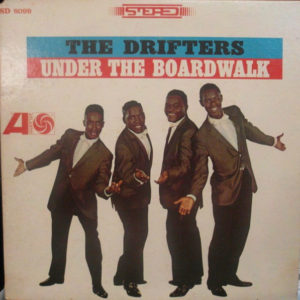 “Under the Boardwalk” was recorded the day after their lead singer Rudy Lewis died. They recruited a former member from several years ago, and before long a new version of the group had cranked out their second-biggest hit.

 In 1975 Aerosmith was pretty much just another rock band with a modest hit, but when they got writer’s block, a trip to a Mel Brooks movie inspired them to come up with a title, and then Steven Tyler wrote the lyrics over the next day or so–twice, as the story goes. The song was a hit, and ten years later, it was a hit again when Aerosmith teamed up with rap act Run-DMC to cover the song. Check out the video; it’s fun, it’s very creative, and you barely notice that most of the band is missing: