180: Green River

Hidy, friends and neighbors. Good to be partnering up with Claude on another podcasting project! This episode is about a song whose title vaguely sounds like the result of a chemical spill, but which is actually a classic piece of rockabilly.

John Fogerty and his brother Tom were natives of Northern California, and their family vacations often were to a cabin in Yolo County, just west of Sacramento. That cabin was next to both a lake and a creek, and the Fogerty boys would play in and around that creek during vacations. And yes, you’ve guessed it, the water there did have a greenish tint because of algae and other natural phenomena.  Coincidentally, Green River was John’s favorite flavor of soda pop as well (though I’m not sure I would drink anything with that name these days).

Fast forward a few years to the mid 1960s, and John and Tom, along with their buddies Stu Cook and Doug Clifford, are in a local band called the Golliwogs. They picked a new name in January 1968, shortly after they got their record contract, and were thereafter known as Creedence Clearwater Revival. They followed the natural route of local gigs, then national tours, and then record releases. The song titles are familiar: Susie Q, Bad Moon Rising, Born on the Bayou, Proud Mary (which Claude covered on an episode of How Good It Is a while back, and then the song that hearkened back to John’s salad days at that creek in Yolo County.  

Give it a listen to see how Roy Orbison rubbed off on the boys from El Cerrito, and how the song fits into the overall CCR legacy.

Click here for a transcript of this episode. 

Click here to become a Patron of the show.

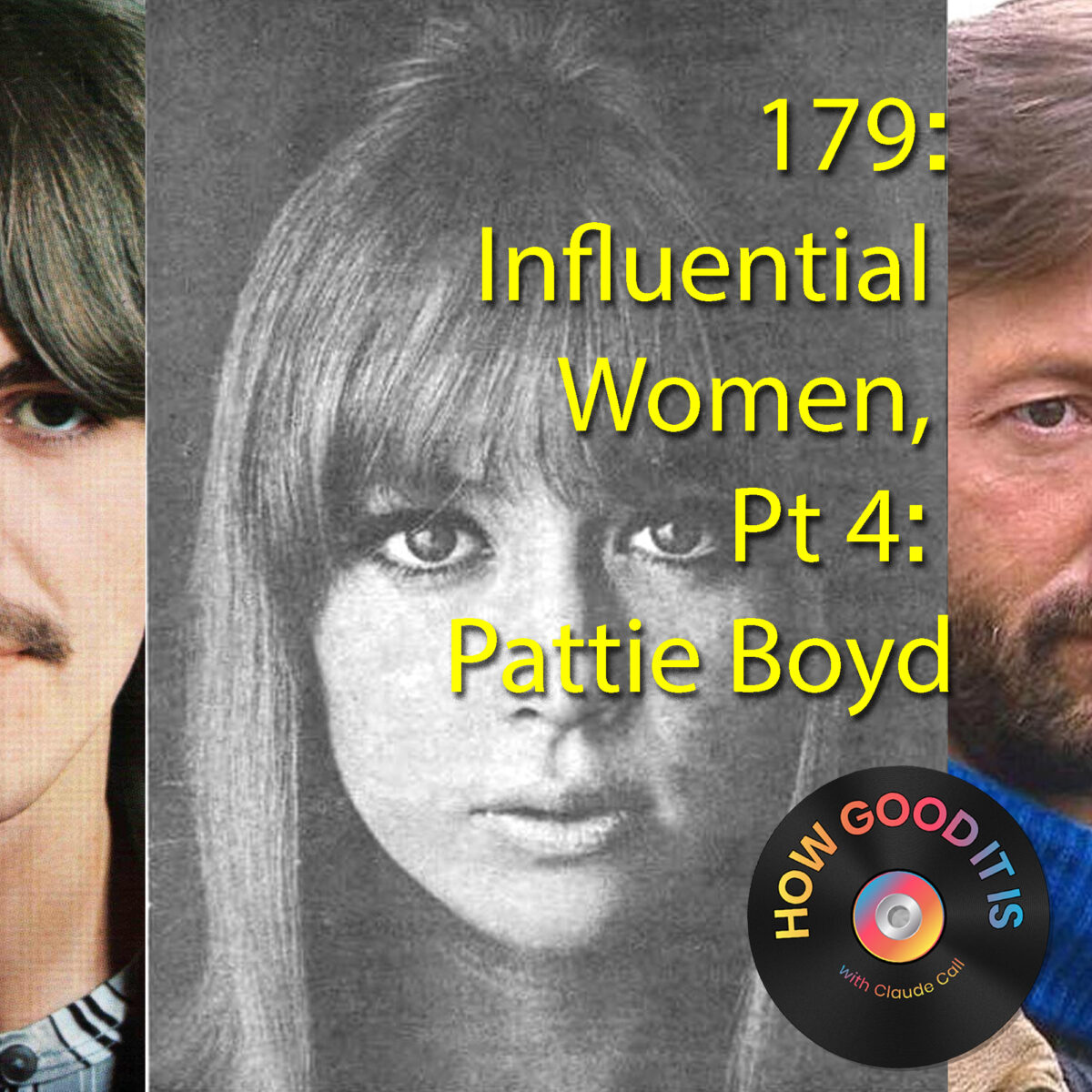
179: Influential Women, Pt. 4–Pattie Boyd

Ladies and Gentlemen, the queen of them all.

Pattie Boyd was the inspiration for a huge number of songs. Some of them went to the top of the charts, some of them weren’t released as singles, but nearly all of the songs about her are well-known, and not just because they’re about her; because they’re actually pretty darn good.

And the crazy part is that all of them came from two men: George Harrison and Eric Clapton. There’s a song in Clapton’s catalog that could have easily been about her if you try to read into the lyrics, but it’s more coincidence than anything else, since it wasn’t written by Clapton. But it’s also quite possible that the lyrical content is one of the things that gave it its appeal to Clapton. Who knows.

When I return to this topic (in two episodes), we’ll talk about the other contender for the big title.

If you’re a Patron of the show, you’ve already gotten this episode in your Patreon feed. Feel free to listen again here, if you’re so inclined. Newsletter should be back next week; I’m still readjusting my work flow. You can click here to become a Patron of the show.

Click here for a transcript of this episode. 

160: Failing Upward, Vol 2

Pardon my allergies; I’ve sounded kind of rough for a week or so. There was a lot of throat-clearing to edit out of this one. I can’t even blame the Southern Studio on this one; it’s the direct result of spending too much time cutting the grass at home. (And THEN I can blame the Southern Studio a little bit, because I went there the next day and it certainly didn’t help matters.)

How does one spend too much time cutting the grass? By having an electric mower and starting the job with a battery that isn’t fully charged, that’s how.

This is an episode topic I’ve wanted to return to for a long time, but for some reason I kept procrastinating. But way, way back in Episode 11, I featured a bunch of songs that had mistakes in them which were discovered before the final product was released, but they decided they liked it better that way and ran with it. And today we return to that well for another dip.

The tough part with songs like this is curating the best ones to use. Led Zeppelin often left in stray noises because they didn’t really care (ringing phones), or because they were actually counting on it (squeaky pedal on Bonham’s drum kit). So finding one that was both inadvertent and improved the recording? Absolute Gold, Jerry. Similarly, The Beatles would make an error in rehearsal or elsewhere and decide that that was something they needed to retain/reproduce (e.g. the wine bottle rattling at the end of “Long Long Long”), so those weren’t really good candidates.

And, of course, you run into a story which is just plain wrong. Yes, Ronnie Van Zant was talking to the board operator when he said “turn it up” while recording”Sweet Home Alabama,” but he did not mourn the loss of doughnuts near the end. (What you’re hearing is, “Montgomery’s got the answer.”)

At any rate, I finally buckled down and did the necessary research, and I hope you have fun with this one as much as I did.

Incidentally, a big shout-out to the newest member of our Wall of Fame. Everyone say hello to Cousin Robert! If you want to join the family, you can click here to become a Patron of the show.

Click here for a transcript of this episode.

139: And When I Die

Laura Nigro was a sixteen-year-old musical prodigy who was trying on several last names, as creative types sometimes do. She happened to be “Nyro” when she finally started to catch on in the music industry, so Laura Nyro she became.

Nyro was never a huge star in her own right. But she left behind a musical legacy in a bunch of songs that became big hits for other artists. That’s a roster that would include Three Dog Night, the Fifth Dimension, Barbra Streisand and Blood, Sweat and Tears.

Nyro wrote “And When I Die.” Peter, Paul & Mary made it kinda-sorta famous. But it was Blood, Sweat and Tears that really brought it to the fore. David Clayton Thomas’ voice, combined with Dick Halligan’s arrangements made for a relatively light-hearted romp through the graveyard. And while BST’s version is musically different from Nyro’s, they never lost sight of that gospel feel that it had, even as they gave it the cowboy instrumental section.

In doing the research for this show, I went down a little bit of a rabbit hole of listening to Laura Nyro’s music. I may have to do a whole bunch of shows dedicated to her sometime soon. Nyro is definitely an under-appreciated talent.

Click here to become a patron of the show.

Click here for a transcript of this episode.

127: Foreign Influence

I don’t know why it fascinated me so much recently to poke around with songs that had foreign lyrics in them. But, here we are. This week’s show (and I promise I’m done with the premise for awhile) looks at four songs between 1969 and 1984 which have non-English phrases in them. Some of them have been hilariously misunderstood for a long time. One of them is pretty obvious but I decided to throw it in anyway. And one may come as a surprise to you, especially if you don’t speak Spanish.

As promised, here’s an episode of the European game show Jeux Sans Frontières from 1975. This episode comes from Engelburg, Switzerland:

And here’s another, airing from Vilamoura, Portugal in 1980:

And just for laughs, here’s this week’s episode:

Click here for a transcript of this episode.

Click here to become a patron of the show.

115–Cold Turkey

So I’m sitting here in my home office-slash-podcast studio, researching and writing this week’s episode, and setting up the audio clips, and my dog is sitting at my feet pretty much the entire time. And as soon as I cracked the microphone open, he decided he needed to leave the room. Did he need to go outside? No. He just wanted to be in the next room. How’s that for a criticism?

Ah, well. At least I have you. Right? RIGHT??

John Lennon’s first non-Beatles single for which he gets sole writing credit was misunderstood and probably alienated Beatles fans, but you can’t deny the power of Eric Clapton’s guitar riffs and the claustrophobia of the mix provided by Klaus Voormann’s bass and Ringo Starr’s drumming. And it should be noted that the moaning and screaming at the end actually pre-dates Arthur Janov’s book The Primal Scream, so once again Lennon was a little bit ahead of his time. (Albert Goldman’s book about Lennon suggests that he and Mick Jagger got advance copies of the book, and that John Lennon actually underwent primal scream therapy for awhile. However, Goldman’s book appears to have only a casual relationship with the truth.

It’s allergy season and I’m sounding great, my friend. Have a listen.

Click here for a transcript of this episode.

Episode 106–Proud Mary

John Fogerty had already picked up some popularity with his band The Golliwogs, but Uncle Sam came a-calling in 1966. In order to avoid being sent to Vietnam, he instead enlisted in the Army Reserves, where he served for a while until he was discharged honorably.

In the days that followed the discharge, he wrote a song that he knew immediately would be a hit on the level of the bigger songs of the Tin Pan Alley days. And, given that other artists recorded the same song within a few months of its release, he was correct in that regard.

The new owners of their label, Fantasy Records talked the band into changing their name to something a little less offensive in exchange for the opportunity to record a full-length album (rather than the singles they’d been making), and the band, not being fools, agreed immediately. The original name had come from Fantasy’s previous owner, so they weren’t really married to it anyway.

Thus it was that The Golliwogs became Creedence Clearwater Revival, and Bayou Country their first album.

Click here for a transcript of this show.

Episode 105–Under the Covers, Part 6

True story: I hire models from Fiverr to do these pictures. All three of them, coincidentally, are from the same (non-US) nation. I don’t do that on purpose but I’m starting to think I have a “type”.

Thanks for your patience as the show migrates from one server to another. As I noted on the social media, I’m working hard to make it as invisible as possible if you listen via Google or Apple or Spotify, etc. And the website here is going to look kind of weird for awhile with a lot of double posts for previous episodes, until I pick my way through and fix them, one by one. Fun, Fun, Fun!

This week, we’re taking yet another look at a few songs which you may not have known were covers, and nearly all of them were suggested by a listener named Kim, who didn’t feel that a shout-out was necessary, but obviously I don’t feel the same way. Kim had a list of songs that could work, and I said “Sure” to most of them, with a single exception, and that’s mostly because the story is a little convoluted and I may have to turn it into an episode of its own down the road a ways.

Anyway: a new hosting partner means a new player here on the webpage for you, and I do have a little bit of customizing control over it (something I didn’t previously have at all), so I’m happy to hear your suggestions. And, of course, please let me know if you hit any weird technical snags.

Finally, as promised: here’s the original French song I discussed during the show. Check out those lyrics; it’s rather poignant.

Click here for a transcript of this episode.

Episode 102–The First Time Ever I Saw Your Face

Roberta Flack was one of those artists that the label couldn’t quite pigeonhole, which meant that they couldn’t find a way to make her accessible to listeners. As a result, her first two albums got some positive press, but the sales weren’t especially great.

It wasn’t until after her second album came out that a track on the first album caught the attention of a first-time movie director by the name of Clint Eastwood. He called Flack at home and asked if he could use the song in his film, a psychological horror film about a disc jockey called Play Misty For Me. It took a little bit of convincing (about two thousand dollars’ worth), and the song made it into the film.

When Play Misty For Me turned into a hit, Atlantic Records finally saw the light and released a slightly shorter version of the song on a single, and it became the first of several big hits for Flack over the next few years.

What most people don’t realize is that Flack’s recording was a cover of a song written and recorded in 1957, and covered rather faithfully several times after that. But once it hit for her, the covers began to sound more like Flack’s version. And while the song finally becoming a hit made its writer a ton of money, the truth is, he’s never really liked anyone else’s recording other than the one his then-girlfriend made.

Image result for danger will robinson gif -site:pinterest.com

Incidentally, here’s the link to the Flaming Lips/Amanda Palmer video that I discuss during the show. It’s definitely Not Safe For Work. You have been warned.

For you independent types who don’t use Google Podcasts or some other podcatcher software, here’s the show for your listening/downloading pleasure:

Click here for a transcript of this episode.

Episode 89–Woodstock

The Summer of 1969 was also the Summer of Woodstock. Hundreds of thousands of people made their way to Max Yasgur’s farm in Bethel, New York (they couldn’t get a permit for the town of Woodstock, but the posters had already been made, and you know how it goes…) for a few days of Peace, Love and Music.

Woodstock proved to be like nothing else, before or since. Attempts to replicate its feeling, or its scale, or anything else about it gets washed away by nostalgia and the sense that someone’s trying to make a buck off of it. And, of course, they are. They were trying to make a buck off the original show, too–in fact, the organizers were hoping to raise money to build a recording studio. That didn’t work out because financially the show barely broke even. But the film and record rights put them back in the black several months later.

Several acts were barely known at the time of the show, including Crosby, Stills, Nash and Young (performing for the second time ever), and Sha-Na-Na, which opened for Jimi Hendrix. Most of them have found a place in the rock and roll firmament following the show (e.g. Melanie was a relative unknown; Richie Havens, who opened the show, was barely known, Santana had been around for ten years but hadn’t broken through yet); others were pretty much unheard-of afterward (Keef Hartley Band? ).

In the wake of the show were three things that gained lasting fame, and they all happened around the same time, in early 1970. The first was this:

The other two? We talk about those in this week’s episode. I’m no spoiler.

Speaking of which, if you want to see the telegram sent to the band in today’s trivia question, look under the spoiler button below this week’s episode.

Finally, this is the text of the telegram related to the trivia question for this episode. See if you can find the hidden message! If you’ve heard the episode and you want to see what I’m talking about, click the button to show the art. If you haven’t heard it yet, go back and listen first. It’s OK, we’ll still be here for you.

Click here for a transcript of this episode.

Click here to become a Patron of the show.